You just changed your Pur water filter, but the light is still blinking red. What gives?
This is one of the most common Pur filter questions, and the answer is usually simpler than you think. Let’s go through what each indicator color means and exactly what to do about it.
A blinking red light after a filter change means the indicator needs to be reset. Press and hold the reset button for the pitcher, or press it 4-5 times for the faucet system.
Why Is My Pur Water Filter Blinking Red After a Filter Change?
If you see a red light, this indicates that your Pur water filter is no longer filtering the water properly (or at all) and you should change it immediately. The red light means that the filter has already filtered over 100 gallons of water, accumulating enough particles and dirt that it can no longer work properly.
If you choose to keep using it past this point, the foul taste or smell and the detrimental properties inside will return, turning your water into a possible hazard to your family.
Not All Water Is Suitable for Drinking
Dirty or contaminated water, even if it looks clean to the naked eye, can contain microscopic particles or harmful chemicals that can cause a significant number of dangerous diseases or unforeseen health problems.
Still, there’s no reason to worry since the solution to that problem is relatively simple. There are special purification filters that you can install and use to have your tap water cleaned before consumption.
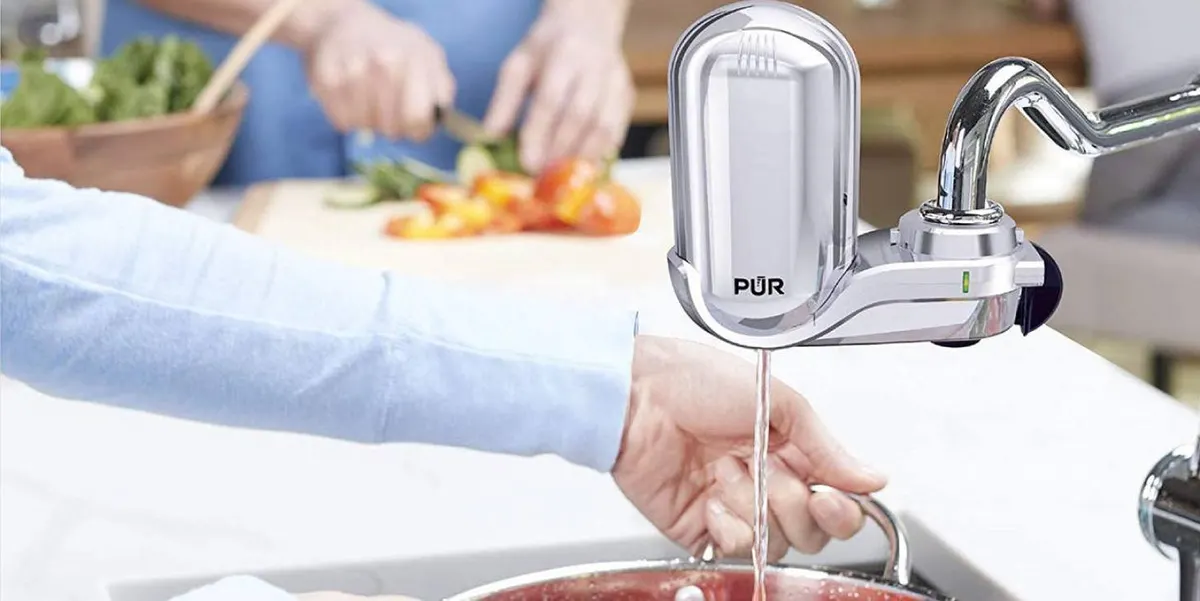
One of the best filtration equipment is the Pur water filter. It comes in two forms, as an attachment unit for your sink and as a specialized pitcher.
The Pur water filter is easy to install, easy to change, and a light indicator can warn you when the filter needs replacing or if there’s another issue and your water isn’t purified.
What Kind of Lights Are There and What Do They Mean?
The Pur faucet filtration system filter filters up to 100 gallons of water, equal to 2-3 months of filtering work, depending on the usage. On the other side, the Pur pitcher filter can purify up to 40 gallons for the same amount of time.
One of the Pur filter’s best features, no matter which type you own, is the user-friendly indicator that can help you make sure your water is clean, delicious, and odor-free. Check its light once in a while and change the filter when it’s time for a new one.
Here is what all the different lights mean:
Green Light
If you see a green light, this indicates that the Pur water filter is working correctly. The green light suggests that the filter is keeping away from your water a variety of harmful particles and substances such as chlorine, lead, mercury, pesticides, iron, arsenic, and others.
This way, you can good news — that your family is drinking clean, danger-free water while still receiving useful minerals like calcium and magnesium that could be found in it.
With the level of pollution and heavy metallurgy at work all around us, it’s no surprise that our food, water, and air are more harmful than ever. But while we work to balance the scales with Mother Nature, we need to be mindful of our health and take special care with our sustenance.
Yellow Light
If you see a yellow light, this indicates that your Pur water filter is nearing the 100 gallons (or 40 for the pitcher filter) milestone and may soon require a filter change. To purify your water, the Pur water filter gathers all the harmful particles and contaminants in itself, so it’s only natural that with time it gets clogged.
Once this happens, instead of selectively letting through clean water, it will start to allow harmful substances, resulting in dirty, undrinkable water. The Pur company advises changing your filter before the indicator light goes to red.
This would prevent you from consuming any harmful matter that may have slipped through, considering that the filter isn’t working at the ideal level anymore.
Red Light
As mentioned above, a red light can indicate a filter that’s malfunctioning and that you need to change it immediately. The red light means that your filter has already completed the filtering of 100 gallons of water and has accumulated enough dirt and particles to where it can no longer function properly.
Most Common Issues You Can Face with Pur Water Filter
While we wish all things were easy and would never break, that’s rarely the case in real life. As for the Pur water filter, there are a few things you should know and be ready to resolve any problems with your equipment quickly.
Water Filter Light Is Blinking Red After Filter Change
Sometimes, even after you install a brand new filter, the light may not automatically switch to green. In that case, what you need to do is to reset the indicator. For a step-by-step walkthrough, see our guide on how to change a PUR filter.
To reset the Pitcher Filter:
- Locate the indicator on the top of the pitcher 2.
Press and hold the button for 5-10 seconds 3. Release and wait for the light to flash green
To reset the Faucet Filtration System:
- Remove the system from the faucet 2.
Twist back the cover and remove the filter 3. Locate the reset button on the bottom of the housing 4.
Press it 4-5 times until it pops up 5. Replace the filter and screw the lid back on 6.
Reattach the system to the faucet 7. The light should flash green several times and become solid
If the reset doesn’t resolve the issue, then there’s another possible explanation. Even if you have triple-checked everything and you’re sure all is in order, including the new filter, it’s still possible that some leftover dirt or particles are clogging the filter or the indicator light itself.
In that case, disassemble the faucet filtration system or the pitcher itself. Gently rinse the filter container or pitcher container.
Let it dry fully, then reassemble it. Reset it by following the steps above, and the light should then turn to solid green.
Finally, if none of the quick fixes above resolve the issue, you should consider changing the electronic circuit.
Filter Light Is Not Turning Solid Green
When the light is solid green, this indicates that the filter is working correctly. It’s quite reasonable to see it flash every time you refill the pitcher filter or when you turn on the faucet filtration system filter.
However, the normal behavior is to go to solid green after that.
Yet, occasionally, it may happen so that the light will continue blinking whether you’re using the Pur water filter or not. In that case, what you need to do is clean the filter itself.
Please, keep in mind that this isn’t the same as changing the filter - you still need to change the filter every 2-3 months (or sooner, depending on how dirty the tap water in your area is).
If you have a Pur pitcher filter, take the filter out and blow through it, or use a dental water pick to clean it. For more persistent cases, you may need to use a cleaning agent.
If you’re using the faucet filtration system filter, remove it from the faucet, open it, and extract the filter, cleaning it the same way you would a pitcher filter.
Once the filter is clean, carefully put it back in its place and reset the light indicator. After a few seconds of rapid blinking, the light should go back to solid green.
Water Filter Is Clogged
As we already established, the primary function of the filter is to stop and contain particles so that the water that gets to you is free of them. If you’re dealing with persistent clogs, our guide on how to unclog a PUR water filter can help. So it shouldn’t be a surprise if you turn the tap one day and find it barely dripping.
That’s a good thing. This happens because your filter is doing a marvelous job, it’s stopping all those harmful elements and hanging onto them.
This doesn’t necessarily mean that you need to change the filter. Before rushing to the store to buy a new one, you should do a quick test to see if you need to replace it, or it’s just a simple clogging problem that you can quickly fix.
Please take out the filter from your filtering device and put it in a container with clean water. Leave it there for 24 hours.
If you see a lot of dark particles or the water itself seems turbid, you can thank your filter for their hard work and give it a kind, gentle cleaning before putting it back.
Once you do this, the light should go back to green on the indicator, and the water flow should return to normal. If the clogging persists even after cleaning the filter, then you should consider getting a new one.
The same applies if the light on the indicator is red. If this is the case and your filter is clogged, don’t try to clean it and put it back on.
The Pur water filters have a particular lifespan, and even if you scrub off the accumulated dirt and other particles, that won’t make it work like a new one. Also, keep in mind that some areas where the water contamination is higher than others the filter could be worn out faster. Consider a point of use water filter as an alternative for reliable filtration at specific taps.
Water Filter Is Running Extremely Slow
Two things most often cause weak or slow water flow when using a Pur faucet system filter. The first one is clogging.
As we discussed before, clogging can happen due to the filter accumulating a large amount of dirt and dangerous elements over time. You can resolve this with careful cleaning of the filter itself or with a filter change if over 2-3 months old.
The source that your tap water is coming from is another possible reason for the weak water flow. If you have a whole house system, check out our article on water filter pressure drop. The water comes from a well or another underground source in the rural or secluded areas. If your home uses well water, filtration is especially important.
It’s only natural for that water to be much dirtier or to contain more microelements that need to be removed before it becomes drinkable. So the more the filter needs to work, the slower the process would be, hence the flow will slow down, but the result would be a clean, tasty, and contaminants-free water.
There’s still a way to increase the water flow a bit. You would need a plastic washer and a set of skillful fingers.
You need to take the filter out of the faucet filtering system and locate the two curved wedges inside of it. Their job is to hold the filter apart from the connection, restricting or increasing the water flow depending on their length.
Since those wedges are very short, to begin with, what you can do is place the washer between them and the connection, widening the space where the water flows. That should increase the flow just enough without compromising the filter’s effectiveness.
Water Filter Is Leaking
Leaking from the faucet: Most often, if you notice leaking from your faucet filtration system, it’s because the vacuum of the system is broken, especially after a fresh install or filter change.
Just remove the filter and look inside. You should see a small rubber in the form of the letter O. Learn more about water filter O-rings and how they work.
This rubber’s job is to obturate the space between the filter and the faucet, and if the rubber is dirty or not in its place, water may slip through the hole and leak from the valve.
To check if that’s causing the problem, make sure to clean the little rubber, dry it, and carefully adjust it properly. You won’t need any special tools, you can use your fingers.
Once the rubber is in place, reattach the filter and test the water flow again. If the issue persists, then try to tighten the place where the filter meets the faucet.
If you can’t do it by hand, you can try with a pair of pliers.
Leaking from the top: Any leaking from the top is a sure sign that the faucet filtration system isn’t installed correctly. For whole house systems, see our guide on whole house water filter leaking from the top. To resolve this issue, you need to disassemble it and start from the beginning.
Make sure to dry your hands and all parts from the filtering system since any wetness would make it harder to screw them together. They must be tight, or that may also result in leaking.
It’s imperative to follow the instructions carefully as not to miss a step. Once the filtering system is reattached, make sure to tighten the parts that connect.
You can do that with just your hands, but if you keep slipping or feel the parts are still somewhat loose, a pair of pliers will come in handy.
In case the leaking persists even after your careful work then it’s entirely possible that the filtration system unit is faulty.
Water Filter Is Not Filtering Properly
On rare occasions, the Pur water filter can stop filtering the water properly. Faulty equipment, improper installation of the unit, or a filter that needs changing are often the things that can cause this issue.
The first case, and rarest of them all, isn’t something you can fix. It’s not something you should assume right away either, since most often, the issue comes from the user end. Understanding the dangers of not changing your filter on time can help prevent these situations.
If all the other options check out and the problem persists, then contacting the manufacturer or storing the unit is the only thing you can do. But before going there, you should first check your filter.
Usually, that’s the most natural step. If your filter is older than 2 months or the light indicator is yellow, red, or off, the filter is most likely your culprit.
However, if the filter is relatively new or the light is solid green, you should check the unit installation.
To test that theory, remove the faucet filtration system from the faucet then twist back the cover until it opens. Proceed to remove the filter and make sure the reset button pops up.
Then put the filter back in, making sure it clicks in place. Reassemble the faucet filtration system and tighten it, so it all fits properly.
You should have no problem tasting the water. If you can notice a color, a smell, or a bad or metallic taste, then the filter is still not working. You may want to explore countertop water filters as a more solid alternative.
In that case, you should proceed with contacting the manufacturer or getting a new filtration unit.
Particles in Filtered Water
White Particles
The point of using a filtration system is to have perfectly clean water when you pour some in your glass. So if you notice that some white flakes are dancing at the bottom of your cup, it’s only natural to assume your filter isn’t working correctly.
Funny enough, that’s not the case. Those white particles can appear when the tap water in your area is tight, meaning that it contains a high number of minerals.
All water sources contain minerals such as salt, magnesium, manganese, or calcium, usually visible when the water is cold. A water softener can help address high mineral content.
The bad news is that no filter can entirely get rid of those. The good news is that those particles are harmless, tasteless, and odorless.
Black Particles
Another thing you can notice in your water are tiny black particles. Just as with the white ones, there’s nothing to worry about.
The Pur water filter has in its core activated charcoal that helps with the purification of the water.
If a new filter or water filtration system was just installed in general, you’ll likely see those who forgot to follow Pur’s instructions. Upon installation, you should submerge the filter itself in clean water and leave it there for about 20 minutes.
Then you should assemble the filtration system and let the water run for 5 minutes before tasting it. On rare occasions, even if you’ve done this already, the particles may still appear in your water.
Don’t worry. They will go away after a short time.
Frequently Asked Questions
For the pitcher, press and hold the reset button on top for 5-10 seconds -- it should flash green when it's done. The faucet system is a bit more involved: pull it off the faucet, open it up, find the reset button on the bottom, press it 4-5 times until it pops up, then put it back together. You should see a solid green light.
The faucet filter handles about 100 gallons, which works out to roughly 2-3 months of normal use. The pitcher filter is good for about 40 gallons over a similar timeframe. Once the indicator goes yellow or red, it's time to swap it out.
Those are just tiny bits of activated charcoal from the filter -- totally harmless and really common with new filters. To avoid it, soak the new filter in clean water for about 20 minutes before installing it, then run water through the system for 5 minutes before you start drinking from it.
You can clean it to fix clogging, but that won't restore its actual purification capacity. For pitchers, try removing the filter and blowing through it or using a dental water pick to clear debris. Either way, replace the filter every 2-3 months -- cleaning just buys you a bit of time.
Final Thoughts
So if your Pur filter is blinking red after a filter change, it's almost certainly just a reset issue. Takes about 10 seconds to fix.
Pur filters are genuinely one of the easiest ways to get cleaner water at home. The faucet attachment and pitcher are both simple to use, affordable to maintain, and they do a solid job removing the stuff you don't want in your drinking water.
Just remember to reset after every filter change, replace on schedule, and you'll rarely run into problems.
Always reset the indicator after installing a new Pur filter. For pitchers, hold the button for 5-10 seconds. For faucet systems, press the reset button 4-5 times.