If you’ve installed a whole house water filter and noticed your water pressure isn’t what it used to be, you’re not alone. It’s one of the most common complaints, and it’s usually fixable.
Several things affect water flow — pipe size, source water quality, the filtration media itself, and even your municipal supply pressure. As a filter does its job trapping contaminants, the flow rate naturally decreases over time.
The trick is choosing the right system upfront and staying on top of maintenance. This guide covers why pressure drops happen, how to prevent them, and what to do when your water slows to a trickle.
A pressure drop in your whole house water filter is most commonly caused by a clogged filter cartridge or an undersized system. Replace filters on schedule, choose a system sized for your home's peak demand, and monitor pressure regularly to catch problems early.
Understanding the Water Pressure Mechanism
When turning on any available house faucet, we rarely think about how the water is coming out. Water pressure reflects the measure of the force in which water flows through our pipes.
This pressure is key to push the water through the pipes within our homes and businesses. There will be disturbances about the adequate functioning of many appliances if the pressure is low.
Municipal water systems are responsible for distributing water to most households. Through this method, we usually extract water from various groundwater sources and then treat it to remove impurities.
Pumping to water towers is generally the next step in this process. Then comes the role of gravity to provide the pressure that forces the water through pipes and finally to our homes.
A similar process can take place in closed systems, as well as in lakes and reservoirs. Old infrastructure issues with the city system can deeply impact water pressure quality at your home.
What Can Also Impact the Water Flow Rate
Also, homes with conventional private wells will often face inadequate or lower water pressure issues too. Choosing the best sediment filter for well water can help minimize pressure loss. The pressure of the water may vary based on the current position with the water source, as well as with the system that’s delivering the water in.
Plus, water pressure variation may change differently across the day. When there’s less demand for water, pressure quality increases, which is usually noticeable at night.
Regardless of the cause, fluctuating water pressure and flow can lead to significant disorders within your house.
We explained the water pressure mechanism on a global scale earlier. It’s important to highlight more specific factors as they play a critical role in defining the flow rate quality for water.
The pipe length could be a determining factor in understanding how pressure can drop in a water system.
The Ever-Pressing Need to Remove Contaminants
Removing contaminants from water has become essential to the wellbeing of households and humans in general. We came to know gradually that tap water is likely to contain harmful contaminants like toxic chemicals and heavy metals.
Consumers have become a generation of plastic users. People are increasingly noticing that plastic water bottles now clog our offices and homes.
In this regard, having a filtration system can be useful in removing contaminants from water.
However, an essential factor that plays against maintaining a steady water flow lies with the potential presence of various filtration mechanisms within house water systems.
The Right Decision Before Any Engagement
As we came to know that equipping our homes with filtration systems has become genuinely essential, homeowners will need to ask the fundamental question: Are Whole House Water Filters worth it? In other words, it’s important to consider whether you’re filtering for the whole house or just for drinking water or cooking needs.
Any homeowner who was blessed or cursed with a sensitive nose, with the ability to detect the smell of metal or chlorine from far away, would love to have a decent whole house water filter. The same is true for anyone who is slightly health-conscious and was exposed to the negative press communications around water quality in the US in recent years.
We can’t hide our intent not to be counted among a high number of the American population that’s still drinking, cooking, and showering with unsafe water.
Making Your Choice for the Water Filter
Going for the right decision to select a quality whole house water filtration system is needed. Homeowners can enlighten their choices when they take into consideration various relevant criteria.
Initial steps will allow for most of the troublesome contaminants to be removed right before they reach your house pipeline. Choosing a good water filter for the home involves asking a few questions before getting one.
What Does It Filter Out?
Most manufacturers design whole house filters to filter out sediments with sizes of up to 0.35 microns. Removing chlorine, iron, and heavy metals are among the tasks for these systems.
Some of them can even include a water softener, UV light purifier, and other particular gadgets to make sure the water is completely purified.
We don’t always need a fancy system that filters out everything. We need to keep in mind that conducting water tests to see what’s in it first would be an excellent approach to embrace.
If your water is already safe and all you want is for it not to smell like a public pool, a single GAV cartridge is most likely more than sufficient.
Does It Meet NSF Standards?
It will be great if your filter is certified by the NSF, the National Sanitation Foundation. This will reinforce the assurance about quality for the target products to consider.
On top of that, you can check if it has a WQA (Water Quality Association) seal on it.
These certifications mean the filter has proved its quality through vigorous testings conducted by the most prestigious organizations in America. A product that’s not NSF certified doesn’t necessarily mean it’s of poor quality.
The cost to get the certifications could be extremely high in some instances.
Manufacturers will then need to include the cost in the product price for more accurate profitability calculations. Smaller enterprises may not be able to afford it.
Some firms are finding alternative ways by doing the testings in independent labs against NSF/ANSI standards. These types of certifications can be meaningful when conducted by trusted labs.
Filter Life
Installing a whole house filtration system isn’t as simple as we can think. This could be time-consuming and truly complex in certain situations.
Even replacing a cartridge can require some techniques, and you may have to resort to calling a plumber if you’re not familiar with this work.
Nobody wants a whole house filter that requires changing every couple of weeks or even months. As these kinds of tasks are usually quite complicated, this involves turning the water on and off a few times, which can cause inconvenience for the family.
In this regard, some filters can be useful for years or even a decade, depending on the quality of your water and the amount you use. We’d recommend going for those systems that can do the job for at least six months straight in one sitting.
Are We Paying for What We Need?
It’s important to objectively assess your real needs before going for the right price to spend. You can’t play with your health and select the cheapest alternative, as this won’t be that wise.
As an example, if you already have soft water available, it will be a waste of money to consider having a water softener on the system. Setting your expectations in advance is always important to reduce bad surprises on filtering systems.
This includes the tasks of testing your water to find out what you need to filter out. This could be done on various occasions or during different times of the day to optimize your decision.
That’s the only way to make sure your money is well spent, and it’s highly likely to lead to the right choice.
Homeowners need to follow the same approach to choosing to get the filtering system for the whole house or just for drinking water or cooking needs. A/B testing-based approaches can have tremendous benefits in lowering the risks for potential pressure drop.
Homeowners need to embrace a practical testing methodology to install an adequate filtering system. When you install a system that’s really based on your actual needs, you’ll have higher chances for this system to last longer with fewer maintenance costs.
Answering the Right Questions
You can assess your needs on the subject by simply asking the question: What issues am I trying to resolve when installing a whole house water filter? Can simply installing a filtering system for cooking or drinking water be a better fit?
To better answer these types of questions, you need to reflect on your previous experiences as a homeowner. Besides, you may also ask your neighbors about the current living conditions in certain areas if you’ve recently relocated.
If homeowners are new in the area, they can undertake the right benchmark research by asking their neighbors about current water conditions. They can also ask about whether their filtering systems have expressed some issues recently and what the related causes were.
We advise you to approach your neighbors with that transparency level and openness mindset. This can pay off for you to combine building new connections while receiving invaluable advice about similar installation experiences.
Once you assessed all the necessary needs for the matter, you can move to the implementation phase.
Choosing the Right Whole House Water Filter
You need to keep in mind that knowing the adequate technique of installing a whole house water filter plays a vital role in troubleshooting any potential issues later, particularly with pressure drop. We highly recommend asking for an expert’s service or advising if you lack actual knowledge on this subject.
We also suggest getting some basic knowledge transfer techniques from the expert when conducting the implementation. This can help when a potential pressure drop occurs.
Home water filtration systems have lots of variety and filter types. Before choosing which type to install in your house, getting to know more about the multiple types and uses for systems is very useful.
Filter Types
Reverse Osmosis
For numerous reasons, reverse osmosis (RO) water filtration systems are quite popular. This type of filter system is simple and not complicated.
This filtration system forces tap water through a semipermeable membrane filter, and through this process, dissolved inorganic solids could be removed using your household water pressure.
Many American households use RO because it’s considered a good water filtration option. It features producing water that tastes good and can handle the job in an effective manner.
It displays reasonable pricing, and no user involvement is necessary as filters are automatic. It will also help you avoid buying cases of expensive bottled water.
Carbon Filtration
Carbon filters are presented with multiple options for use, and people have known that these systems are very useful. Some consider it one of the most popular types of home water filtration.
Carbon filters will remove particles in the range of 0.5 micrometers up to a full 50 micrometers.
The principle of chemical absorption has the feature to remove impurities and contaminants from tap water through using activated carbon filters. Active charcoal carbon filters will remove chlorine, odors, and sediment while improving the taste of water.
However, carbon won’t remove minerals and salts from filtered water.
Ion Exchange
What’s distinguishable with ion exchange filtration systems is that they can soften the water supply coming into your home. Filtration systems that work on purifying your home drinking and cooking water consider water softening capabilities as a vital output today.
Installation Types of Filtration Systems
Installing a filter system depends on personal preference and comes through different formats: countertop, under-sink, and whole house system. The type of system, scale, and complexity will determine the cost to buy and ease of installation.
Under-Sink Installation
If you want to eliminate the large filters on the ends of your kitchen faucet arm, then you can consider this type of installation. However, if you’ve several bathroom sinks, you should consider a different type that’s a whole house based system.
Selecting the under sink alternative won’t be that cost-effective if there are a multitude of sinks to equip.
Whole House Installation
These are the most complete and complex systems for your home. Typically, whole house installations are used when you care about your home water quality in more than two locations in your house.
The installation of these filtrations is identical for all filter types since they differ only in the way water is filtered and the contaminants they eliminate.
If you’ve chosen to make this a DIY project, then consider specific tools to ease your work, such as two adjustable wrenches with different sizes and a tubing cutter. You need to preferably choose a location near the main water supply for your home.
Making sure to facilitate the replacement of the filters in your system is essential. Don’t forget that you’re filtering the entire incoming water supply for the whole house.
Whole House System Installation Practical Steps
If you want to install a whole home water filter system as a do-it-yourself approach, then you may follow the steps below. In the first place, you need to make sure you’ve enough space under the filter system to change the filter when necessary.
Selecting an easily accessible location near the main shutoff valve is essential.
You may handle the cutting of the pipe and install a new shutoff valve with care. An adapter on each side of the filter could be essential.
The next step involves assembling the filtering system. To make an accurate and useful cut, you need to mark the pipe accordingly with high precision.
You’re reaching the phase of the new filtering system installation. Make sure to slide on the compression rings and put the nuts accordingly with care.
You need to make sure nuts are tight to make a secure connection. Proceed in turning the water back on at the main valve, and you may want to check about potential leaks that are coming up.
You’ve now successfully installed an effective whole house water filtration system. You can also ask for the services of experts if you feel more comfortable with this option.
Asking for the help of professional firms with genuine service quality could save you a lot in terms of time and money about these installations.
How to Increase Water Pressure
After installing a whole house filter system, the chances are that you could face possible pressure drop depending on various causes. However, adopting a proactive approach is the best alternative in this regard.
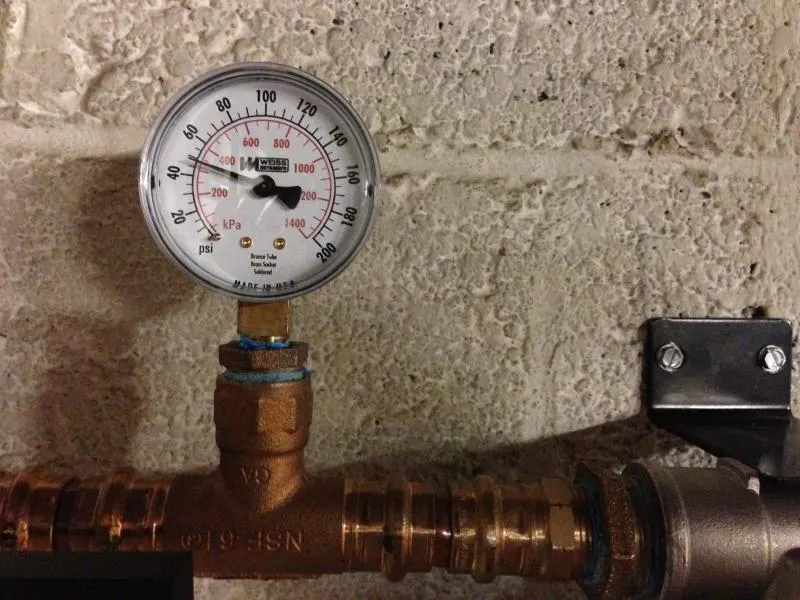
Homeowners need to always follow a monitoring approach by continually measuring the pressure drop. Using a spin-down water filter as a pre-filter can help extend the life of your main filter and reduce pressure loss.
Conducting such measurements will guide you regularly towards a forecasted trend as to potential upcoming issues that may surface. Don’t rush into the alternative of replacing your filter or any specific components before taking the time to diagnose the issue thoroughly.
It will be easier to take the most natural solution for replacement as this happens.
Households can take practical actions to avoid constant replacements of filters, especially if the product has proved to be of good quality. As an example, troubleshooting the issue by isolating the possible area that’s causing the pressure drop is a smart alternative in this regard.
You may also check with your neighbors about whether they’re experiencing the same issue in the area. This will confirm that the pressure drop is beyond the scope of the current system.
Other factors may include infrastructure issues concerning the whole city.
Hence, all neighbors will need to get together to sign a petition asking to modernize the necessary water distribution systems.
Frequently Asked Questions
They do, but it should barely be noticeable with the right system. Any filter creates some resistance because water has to push through the filtration media. If the drop is significant though, that's telling you something -- usually a clogged filter or a system that's too small for your household's demand.
Every 6 to 12 months is the general rule, but your water quality plays a big role. If you notice pressure dropping before the scheduled change, don't wait -- swap it out early. Some high-capacity filters stretch past a year, but that's the exception, not the norm.
Think about your home's peak demand -- how many fixtures could be running at once? Most homes need a system that delivers 10-15 gallons per minute without choking the pressure. If you've got multiple bathrooms and a big family, you'll want something on the higher end of that range.
Plenty of homeowners do it themselves. You'll need basic plumbing tools -- adjustable wrenches and a tubing cutter -- and a spot near your main water shutoff valve. It's a manageable DIY project if you're comfortable with plumbing. If not, a plumber can knock it out in a couple hours.
Final Thoughts
Some pressure drop is unavoidable with any whole house filter -- that's just physics. But a noticeable drop that affects your daily life? That's a sign something needs attention.
Most of the time, swapping the filter cartridge or upgrading to a properly sized system solves the problem completely. The key is thinking about your household's real water demand before you buy, not after.
Stay on top of filter changes, keep an eye on your pressure gauge, and you'll get all the benefits of filtered water without sacrificing the water pressure you're used to.