
Replacing a 10 inch water filter cartridge should be simple. Then you open the housing, find no label, and realize the cartridge in your hand could be one of a dozen types.
We sorted through the 10 inch water filter cartridges that fit standard housings and picked 10 worth your money. Some are sediment filters, some are carbon blocks, and a few handle both jobs at once.
Sizing matters more than brand here. A cartridge built for a slim housing will not seal inside a Big Blue, so we have flagged which size each pick uses.
The PUREPLUS 5 micron 10x4.5 cartridge layers polypropylene sediment media over a coconut shell carbon core. That combination handles rust, sand, and chlorine in one housing stage for up to 30,000 gallons.
Quick Comparison Chart
| # | Water Filter Cartridge | Our Rating | ||
|---|---|---|---|---|
| 1 |  |
PUREPLUS Sediment Carbon | ★★★★★ | Check Price |
| 2 |  |
Pentair Pentek P5 | ★★★★★ | Check Price |
| 3 |  |
iSpring F3 Prefilter Set | ★★★★☆ | Check Price |
| 4 |  |
Pentair Pentek EP-BB | ★★★★☆ | Check Price |
| 5 |  |
PUREPLUS Coconut CTO | ★★★★☆ | Check Price |
| 6 | 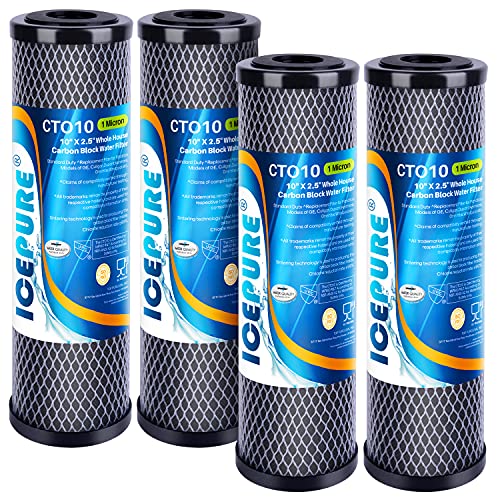 |
ICEPURE CTO Carbon | ★★★★☆ | Check Price |
| 7 |  |
Waterdrop Gradient | ★★★★☆ | Check Price |
| 8 |  |
Culligan SCWH-5 | ★★★★☆ | Check Price |
| 9 |  |
AQUA CREST FXHSC | ★★★★☆ | Check Price |
| 10 |  |
Aquaboon Pleated | ★★★★ | Check Price |
The Best 10 Inch Water Filter Cartridges, Reviewed
1. PUREPLUS Sediment Carbon — Best Overall
PUREPLUS 5 Micron 10x4.5 Sediment and Carbon Cartridge
A Big Blue cartridge that stacks three polypropylene density layers over a coconut shell carbon core. It cuts sediment and chlorine in a single housing stage for up to 30,000 gallons.
Pros
- Handles grit and chlorine without a second housing
- Three density layers trap coarse and fine particles separately
- Rated up to 30,000 gallons on clean city water
- Drops into GE FXHTC, Culligan RFC-BBSA, and Pentek RFC-BB housings
- Keeps beneficial minerals since it does not lower TDS
Cons
- Only fits 4.5 inch wide Big Blue housings
- Well water with heavy silt shortens its life
- Costs more per cartridge than plain sediment media
Most homes need two things from a whole house filter: particle removal and better taste. This cartridge does both, which earns it the top spot.
The outer layers are graded polypropylene that catch coarse dirt first, then finer silt near the core. Inside sits activated carbon made from coconut shell, and that pulls out chlorine.
Running one cartridge instead of two saves a housing, a shutoff, and a seal that could leak. It also wears out all at once, so you track a single change date.
Here’s the deal: the 30,000 gallon rating assumes reasonably clean supply water, and a well with visible sediment will cut that roughly in half.
Add a coarse sediment pre-filter ahead of it, though, and you’ll get much closer to the number on the box.
2. Pentair Pentek P5 — Best Sediment Pre-Filter
Pentair Pentek P5 Spun Polypropylene Sediment Cartridge
The slim sediment cartridge most plumbers reach for first. Its gradient density traps coarse grit outside and fine silt near the core, with almost no pressure loss.
Pros
- Only 0.2 psi pressure drop at 5 gallons per minute
- Gradient density holds more dirt before it clogs
- Pure spun fiber adds no taste, odor, or color
- NSF/ANSI 42 certified for material safety
- Fits any standard slim 10 inch housing
Cons
- Removes particles only, not chlorine or chemicals
- Single cartridge packs cost more per filter than bulk
Pentair has made the P5 long enough that nearly every slim housing was designed around its dimensions.
That 0.2 psi pressure drop matters more than it sounds. A clogged sediment filter is the most common cause of a whole house pressure drop, and the P5 starts with almost none.
It’s made from spun-bonded polypropylene fiber, which carries no binders or resins. So nothing leaches into the water and nothing changes the taste.
Just be clear on what it doesn’t do. This is a particle filter only, so chlorine, taste, and odor pass straight through.
3. iSpring F3 — Best RO Prefilter Set
iSpring F3 Six-Month Reverse Osmosis Prefilter Pack
Three matched cartridges that cover stages one through three of a standard reverse osmosis system. You get a sediment filter, a granular carbon filter, and a carbon block.
Pros
- Replaces all three prefilter stages in one order
- Protects the RO membrane from chlorine damage
- Each cartridge is sealed separately to stay fresh
- Fits most standard 10 inch under-sink RO systems
Cons
- Does not include the reverse osmosis membrane
- Only useful if you run a multi-stage system
- Three cartridges means three seals to check for leaks
If you run an under-sink RO system, this pack solves the annoying part of ownership. Instead of tracking three cartridge types, you order one box twice a year.
The order matters here: sediment goes first to catch particles, then granular carbon, then the carbon block right before the membrane.
That last stage is doing critical work, because chlorine destroys reverse osmosis membranes. The carbon block is the only thing protecting a $70 part.
Here’s the thing: the membrane isn’t in this pack, and it doesn’t need to be. Membranes last two to three years, a different schedule than the prefilters.
4. Pentair Pentek EP-BB — Best Big Blue Carbon
Pentair Pentek EP-BB Big Blue Carbon Block Cartridge
A bonded powdered activated carbon block sized for 10 inch Big Blue housings. Its high porosity design keeps pressure loss low across a 22,000 gallon service life.
Pros
- Better chlorine reduction than typical 10 micron carbon blocks
- High porosity design keeps flow steady as it fills
- NSF certified for material requirements
- Works to 180 degrees Fahrenheit for hot water lines
- Drop-in fit for any 10 inch Big Blue housing
Cons
- Carbon blocks clog faster than sediment media on dirty water
- Needs a sediment prefilter on well water to reach full life
Buy this one when chlorine taste is your main complaint and you have a Big Blue housing. Pentair uses bonded powdered carbon rather than loose granules, packing more surface area into the same space.
The 5 micron rating puts it ahead of the 10 micron blocks that dominate this size. Finer pores mean more contact between water and carbon, and contact time drives carbon filtering performance.
The 180 degree rating is unusual and useful. Most carbon blocks stop near 125 degrees, so this one can sit on a hot water line.
Give it a sediment filter upstream on a well, since carbon blocks are dense and clog fast when raw sediment hits them.
5. PUREPLUS Coconut Shell CTO — Best for Chlorine Taste
PUREPLUS Coconut Shell Carbon Block CTO Cartridge
A sintered coconut shell carbon block tested to NSF/ANSI 42 by IAPMO. It targets a 99 percent cut in chlorine, sand, rust, and color across 30,000 gallons.
Pros
- Tested and certified to NSF/ANSI 42 by IAPMO
- Sintering process gives finer particle capture than loose carbon
- Meets EC 1935/2004 food-grade rules and Australian Water Mark
- Three cartridges per pack lowers the cost per change
- BPA-free construction throughout
Cons
- Built for city water, not raw well water
- Fits 4.5 inch Big Blue housings only
- Carbon media needs replacing on schedule to stay effective
Chlorine is the most common taste complaint on municipal water, and this cartridge is built for it. The NSF/ANSI 42 standard it is certified against covers exactly that: chlorine, taste, odor, and other aesthetic problems.
Coconut shell carbon has a finer pore structure than coal-based carbon, which suits chlorine and light organic compounds. That covers what most city water needs.
Buying three at once changes the economics, since one box covers a 3 to 6 month schedule for over a year.
PUREPLUS is also direct about the limits. This cartridge isn’t built for well water, and the company points you to a different model if that’s your source.
6. ICEPURE CTO Carbon — Best Slim Carbon Value
ICEPURE 1 Micron Slim CTO Carbon Sediment Cartridge
A 1 micron coconut carbon block for standard slim housings, sold four to a box. It reduces chlorine taste and odor while holding beneficial minerals in the water.
Pros
- One micron rating catches finer particles than most carbon blocks
- IAPMO certified against NSF/ANSI 42 for chlorine reduction
- Four cartridges cover roughly two years of changes
- Third-party tested for heavy metal reduction
- Fits DuPont, Pentek, GE, and Culligan slim housings
Cons
- One micron media clogs quickly on silty water
- Not suited to untreated well water without a prefilter
This is the slim-housing answer to the PUREPLUS pick above. One micron is tight for a carbon block, and it buys you finer particle capture alongside the chlorine reduction.
ICEPURE had it tested by a third-party lab for heavy metals including mercury, copper, and cadmium. It also leaves calcium, magnesium, and potassium in place, so your total dissolved solids reading barely moves.
That’s the right outcome for most homes, since you want the contaminants gone and the minerals left alone.
But there’s a catch. The tighter the pore, the faster it clogs, so cloudy water needs a 20 micron sediment filter in front. Skip it and you’ll change this every six weeks.
7. Waterdrop Gradient Sediment — Best Multi-Pack
Waterdrop 5 Micron Gradient Pleated Sediment Cartridge
A pleated polypropylene cartridge with a 10, 7, and 5 micron gradient across its layers. Six per box makes it the cheapest way to stay stocked for three years.
Pros
- Three-stage gradient reduces clogging and extends service life
- Pleated surface holds more dirt than a smooth wrap
- Meets NSF/ANSI 42 standards for material safety
- Six cartridges per box cuts the cost per change sharply
- Fits Culligan P5, Aqua-Pure AP110, and WHKF-GD05 housings
Cons
- Sediment only, so chlorine and taste pass through
- Six cartridges take up real shelf space
- Slim 2.5 inch size only
The gradient structure is the interesting part. Water hits 10 micron media first, then 7, then 5, so each layer catches what the one before let through.
That staging is why gradient filters outlast single-density ones. The coarse outer layer takes the load that would otherwise clog the fine inner layer.
Six cartridges is a three-year supply at two changes per year. And nobody enjoys finding an empty shelf with a clogged filter in hand.
Check the compatibility list before you order. It matches Culligan P5 and Aqua-Pure AP110 dimensions, covering most slim housings sold in the US.
8. Culligan SCWH-5 — Best Store Brand
Culligan SCWH-5 Whole House Carbon Cartridge 2-Pack
Culligan's standard-duty carbon cartridge for its own HF series housings. It cuts sediment, rust, and scale at 5 microns while reducing chlorine taste and odor.
Pros
- Reduces sediment and chlorine taste in the same cartridge
- WQA tested against NSF/ANSI Standard 42
- Easy to find in hardware stores if you run out
- Backed by a brand with 85 years in water treatment
Cons
- 4 gallons per minute flow is slower than rivals
- Built for Culligan HF-150A, HF-160, HF-360A, and HF-365 systems
- Three-month replacement schedule on sediment-heavy water
If a Culligan housing is already on your wall, this is the cartridge it was designed around. That avoids the fit problems generic replacements sometimes bring.
The real advantage is availability. When a filter fails on a Sunday, a hardware store beats waiting two days for delivery.
Flow rate is where it falls behind, though. Four gallons per minute suits one or two fixtures, but a shower and a dishwasher running at once will notice it.
Fifteen thousand gallons also sounds generous until you check the fine print. Culligan rates it at three months on typical water, and sediment-heavy supplies pull that shorter.
9. AQUA CREST FXHSC — Best Long Life
AQUA CREST FXHSC Pleated Whole House Cartridge 4-Pack
A pleated food-grade polypropylene cartridge built as a GE FXHSC replacement. Its large pleated surface stretches service life toward 30,000 gallons without a pressure drop.
Pros
- Pleated surface area holds far more dirt than a wrapped filter
- Reaches 30,000 gallons on reasonably clean supply water
- Keeps steady flow with no obvious pressure drop
- Replaces GE FXHSC, Culligan R50-BBSA, and DuPont WFHDC3001
Cons
- Sediment removal only, no chlorine reduction
- Poor source water shortens life well below the rating
Pleating is what sets this cartridge apart. Folding the media into pleats packs several times more surface area into the same cylinder than a smooth wrap.
More surface means more dirt held before flow suffers. So it reaches 30,000 gallons where a spun filter the same size stops around 12,000.
It’s a direct swap for the GE FXHSC, so check the compatibility list if your housing came from GE, Culligan, or DuPont.
That rating assumes clean water, as these numbers always do. The EPA notes that about 10 percent of Americans rely on private wells that sit outside Safe Drinking Water Act rules.
Those supplies vary far more than city water does, so treat the gallon rating as a ceiling.
10. Aquaboon Pleated — Best for Well Water
Aquaboon 5 Micron Pleated Well Water Sediment Cartridge
A pleated non-woven polyester cartridge aimed squarely at well supplies. The deep pleats handle the rust and sand loads that flatten ordinary sediment filters.
Pros
- Deep pleats cope with the heavy sediment loads wells produce
- Non-woven polyester microfiber resists chemical breakdown
- Runs up to 6 months depending on water quality
- Universal fit across most 10x4.5 inch housings
Cons
- No chlorine or chemical reduction at all
- Heavy iron water can stain and clog it early
Well water is harder on filters than city water. Sand, silt, and iron arrive with no treatment upstream, so the first cartridge takes everything.
Aquaboon built this one for that job, and polyester lasts longer against the iron that breaks down some polypropylene media.
Six months is the optimistic end of the range, though. A well with orange staining burns through cartridges faster, and that’s a water chemistry problem no sediment filter solves.
There’s a limit here too: this handles particles and nothing else. Wells with sulfur smell or bacterial concerns need different treatment.
How We Picked These Cartridges
The short answer: we ranked on certification, published capacity, housing fit, and cost per replacement.
We have not lab-tested these cartridges ourselves. Our picks for the best 10 inch water filter cartridges come from published specifications, third-party certifications, and documented owner feedback.
Here is what we weighted:
- Third-party certification. NSF/ANSI 42 or WQA certification from an independent body, not a manufacturer’s claim.
- Verified capacity ratings. Gallon ratings published with stated water quality assumptions.
- Housing compatibility. Confirmed fit lists covering the major housing brands.
- Media type honesty. Products that state plainly what they do and do not remove.
- Cost per filter replacement. Multi-packs and singles compared on price per replacement, not per box.
We also dropped several cartridges you can’t buy anymore. Two picks from our previous version have been discontinued, and stale recommendations waste your time.
How to Choose the Right Cartridge
Put simply, you need two answers: how wide your housing is, and what you are trying to remove from the water.
Choosing a 10 inch water filter cartridge starts with the housing, not the filter. Pull your old cartridge out and measure its diameter.
Match the Housing Width First
A 2.5 inch body means a standard slim housing, and a 4.5 inch body means Big Blue. Both get called 10 inch cartridges, so ordering the wrong width is an easy mistake to make.
Match the Media to Your Problem
Next comes your actual water problem. If you see grit in the aerator screens or rust stains in the toilet tank, you need sediment media.
But if the water looks clean and only the taste is off, you need chlorine reduction instead. Sediment filters do nothing for taste, and that catches out a lot of first-time buyers.
Account for Your Water Source
Your water source shapes the answer too. The EPA reports that roughly 150,000 public water systems serve most Americans, handling disinfection and water purification before anything reaches your tap.
Private wells get none of that, so everything arrives at your cartridge untouched.
The short version: the EPA’s Contaminant Candidate List 5 names 66 chemicals under review for future drinking water regulation, including 1,4-dioxane and bisphenol A.
Standard sediment and carbon cartridges aren’t certified to remove most of them. So if you have a specific concern, a water test matters more than any filter choice.
Micron Ratings Explained
In simple terms, a micron is a unit of length, and the rating is the particle size cutoff for that cartridge.
A micron rating tells you the smallest particle a cartridge reliably catches, and lower numbers filter finer.
Here is how the common ratings break down:
| Rating | Catches | Best used for |
|---|---|---|
| 20 micron | Coarse sand, large grit | First stage on silty well water |
| 10 micron | Fine sand, rust flakes | General whole house prefilter |
| 5 micron | Silt, fine rust, scale | The default for most homes |
| 1 micron | Fine silt, some cysts | Under-sink and RO prefilters |
| 0.5 micron | Cysts, fine particulates | Point-of-use drinking water |
Five microns is the right starting point for most households. It catches what causes visible problems without cutting your flow rate.
What this means for you: going finer is not automatically better. A 1 micron cartridge on cloudy water clogs within weeks, and that drops pressure at every fixture in the house.
Stage Your Filters on Dirty Water
The smarter approach on dirty water is staging. Put a 20 micron cartridge first to take the heavy load, then run a 5 micron behind it.
Each one then lasts longer than a single fine filter would on its own.
What Filter Media Type Should You Choose?
Here is what matters: the media decides what a cartridge removes, and four common types behave differently.
- Spun polypropylene (melt-blown). Gradient density, cheap, low pressure drop. Best as a general sediment pre-filter.
- String-wound. Wound fiber over a core, tough on heavy grit and slow to clog on rough well water.
- Pleated. Folded media with far more surface area, so it holds more dirt and lasts longest.
- Carbon block. Bonded activated carbon for chlorine, taste, and odor. It does not replace sediment media.
Read the media before you read the price. A pleated cartridge outlasts a spun one at the same micron rating, and a carbon block does nothing about sand.
How Do You Know When to Replace a Cartridge?
Pressure tells you before the calendar does.
Watch for weaker flow at the shower or a slow-filling toilet tank, since both point to a cartridge packed with sediment. A returning chlorine taste means the carbon is spent, even if flow seems fine.
Pulling the cartridge is the reliable check. A used sediment filter turns brown or orange, and heavy staining means you should shorten the interval.
10 Inch vs 20 Inch Cartridges
In simple terms, both filter equally fine, but the 20 inch holds roughly double the media and runs twice as long.
The difference is capacity, not filtration quality. A 20 inch cartridge at 5 microns filters exactly as fine as a 10 inch water filter cartridge at 5 microns.
What changes is how much media sits in the housing. Double the length means roughly double the dirt-holding capacity and double the time between changes.
Flow rate improves too, since more surface area means water passes through with less resistance and pressure holds up better under demand.
What you pay for that is space and money. A 20 inch housing needs about a foot more clearance to swap cartridges, and both housing and filters cost more.
For most homes, 10 inch is still the practical choice. It fits tighter spaces, the cartridges are stocked everywhere, and the housing sizes are far more common on the replacement market.
Step up to 20 inch for a large household, a high sediment load, or if you’re tired of changing filters four times a year.
Frequently Asked Questions
Most 10 inch cartridges last 3 to 6 months. Capacity ratings run from about 5,000 gallons on slim carbon blocks up to 30,000 gallons on large sediment filters. Well water with heavy silt can cut that in half, so watch your pressure rather than the calendar.
The PUREPLUS 5 micron 10x4.5 sediment and carbon cartridge is our top overall pick. It handles both particles and chlorine in one body, which saves you a housing stage. If you only need particle removal, the Pentair Pentek P5 costs less and lasts about as long.
Measure your old cartridge or check the housing label first. Standard slim housings take 2.5 by 10 inch cartridges, and Big Blue housings take 4.5 by 10 inch. Then match the media to your problem: sediment filters for grit and rust, carbon for chlorine, taste, and odor.
A 20 inch cartridge holds roughly twice the filter media of a 10 inch version. That means longer time between changes and better flow at the same micron rating. The tradeoff is cost and space, since 20 inch housings need more clearance under the sink or along the wall.
Five microns works for most homes on city water. Drop to 1 micron if you want finer particle and cyst reduction, and step up to 20 microns as a first stage on silty well water. A lower number filters finer but clogs faster.
Final Thoughts
Buying a 10 inch water filter cartridge gets easy once you know two things: the width of your housing and the problem you are trying to fix.
Measure the old cartridge before you order anything. A 2.5 inch slim body and a 4.5 inch Big Blue body both get called 10 inch, and they do not swap.
After that, match the media. Sediment filters like the Pentair Pentek P5 handle grit, rust, and sand. Carbon blocks like the Pentek EP-BB take on chlorine, taste, and odor. The PUREPLUS 10x4.5 does both in one body, which is why it takes our top spot for most homes.