
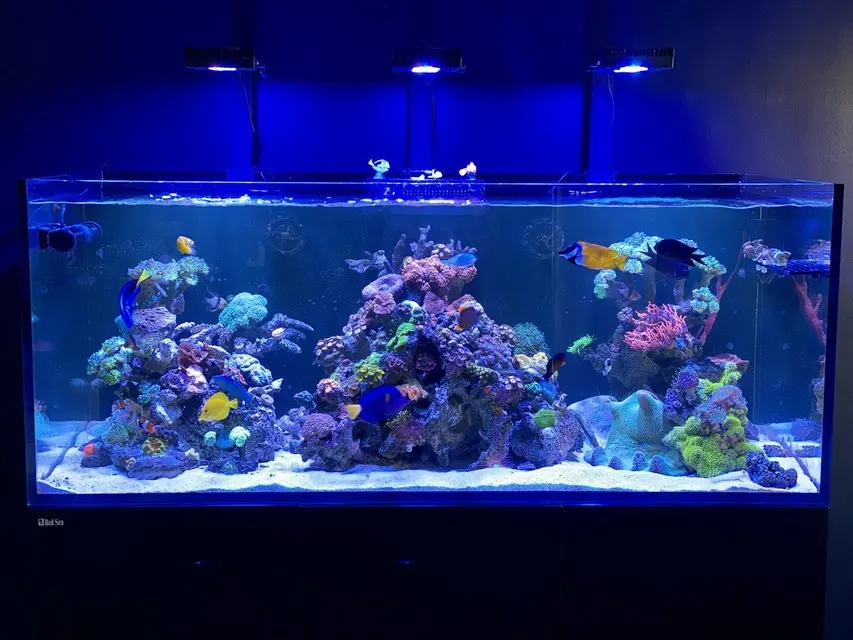
Ask about canister filters on a saltwater forum, and two words come up fast: “nitrate factory.”
One longtime FishLore member said every saltwater keeper they’d talked to who tried a canister regretted it.
Here’s the thing, though. The canister isn’t the problem. The waste that sits and rots inside it is.
Pull that waste out every few days, and a salt water canister filter becomes a solid pick for any tank that can’t take a sump.
Below, you’ll see when a canister makes sense, what to load in it, how often to clean it and which size fits your tank.
Can You Use a Canister Filter on a Saltwater Tank?
Yes, a canister filter can run a saltwater aquarium, as long as you clean its mechanical media every few days and lean on live rock and a protein skimmer for the heavy lifting.
The canister itself doesn’t care about salt.
In fact, plenty of canisters are sold for both. The Aquatop CF-400UV MKII on Amazon is listed as “designed for both freshwater and saltwater tanks,” and the Fluval 307 is listed for “freshwater and marine fish tanks.”
What does that mean for you?
The question isn’t whether a canister works in salt water, it’s whether you’ll keep it clean.
A marine aquarium punishes neglect faster than a freshwater one, because corals and many marine fish are less forgiving of rising nitrate.
Here’s where a canister fits well:
- A fish-only tank that isn’t drilled for a sump.
- A tank you converted from freshwater and don’t want to rebuild.
- Running chemical media, like carbon or Purigen, out of sight under the stand.
Where does it struggle? A coral-heavy tank where you want the lowest nitrate you can get.
Why Do Canister Filters Become Nitrate Factories?
Canister filters become nitrate factories because their sealed trays trap fish waste and uneaten food, and that trapped debris (called detritus) breaks down into nitrate before you ever see it.
You can’t spot the mess through a closed canister, so it builds up quietly.
Here’s how it works:
Bacteria break waste down into ammonia, then nitrite, then nitrate. In a sump, you can see the gunk in a filter sock and pull it out.
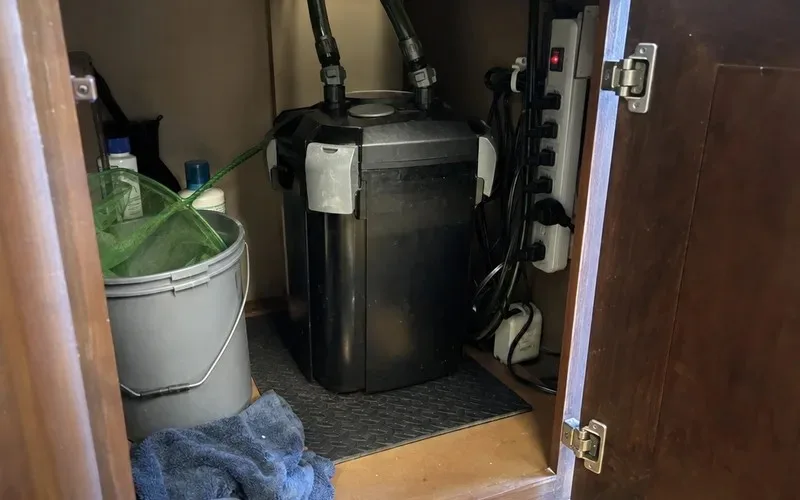
In a canister, that gunk sits in a dark box under the stand. It keeps breaking down every hour you leave it there.
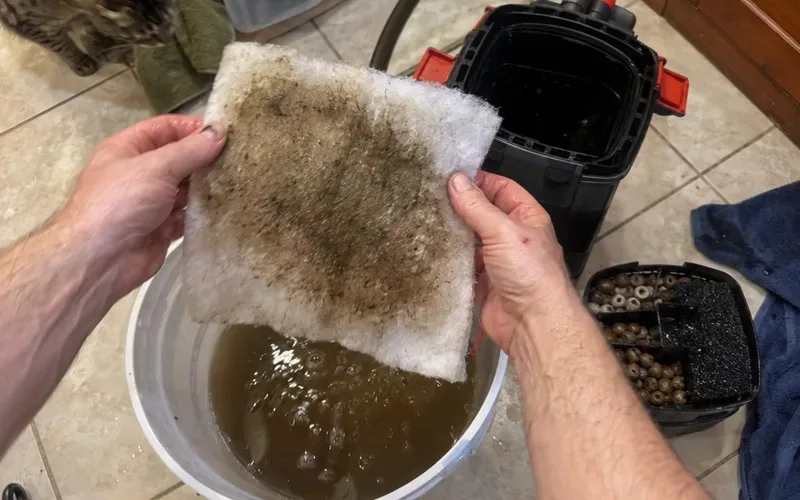
That’s why forum members are so blunt about it. On a FishLore saltwater filter thread, one member told a beginner with a 55-gallon tank, “Go with the sump or you will regret it.”
But look at what they’re really describing. The canister isn’t making nitrate out of nothing.
It’s holding on to waste that you’d otherwise remove. Get that waste out every few days and the “factory” has nothing left to run on.
Canister Filter vs Sump vs HOB for Saltwater
A sump is the strongest choice for most saltwater tanks, a canister filter is a solid second choice for tanks that can’t take a sump, and a hang-on-back (HOB) filter works for small or simple setups.
Which one fits you depends mostly on whether your tank is drilled for plumbing.
A sump is a second tank under the stand that holds most of the filtration. Water drains down to it, passes through a mesh filter sock, a protein skimmer and often a chamber of live rock, then gets pumped back up.
Here’s how the three compare for a typical saltwater keeper:
| Setup | Best for | Main catch |
|---|---|---|
| Sump | Reef tanks, drilled tanks | Needs plumbing and space |
| Canister filter | Undrilled fish-only tanks | Must be cleaned often |
| HOB filter | Small, simple tanks | Little room for media |
So if your tank is already drilled, a sump wins easily, and one FishLore member points out you can set up a sump for about the price of a Fluval 307 canister.
But if your tank isn’t drilled, a canister is a fair trade. Another member on that forum suggested a middle path: convert a big HOB filter like an AquaClear into a mini sump.
Is a Canister Filter OK for a Reef Tank?
A canister filter is OK for a reef aquarium only as a support filter for mechanical and chemical media, not as the main biological filter.
In a reef, live rock and a protein skimmer should do the core work, and the canister just polishes the water.
Why the extra caution?
Corals tend to react to nitrate and phosphate faster than fish do. So a canister’s trapped waste hurts a reef more than a fish-only tank.
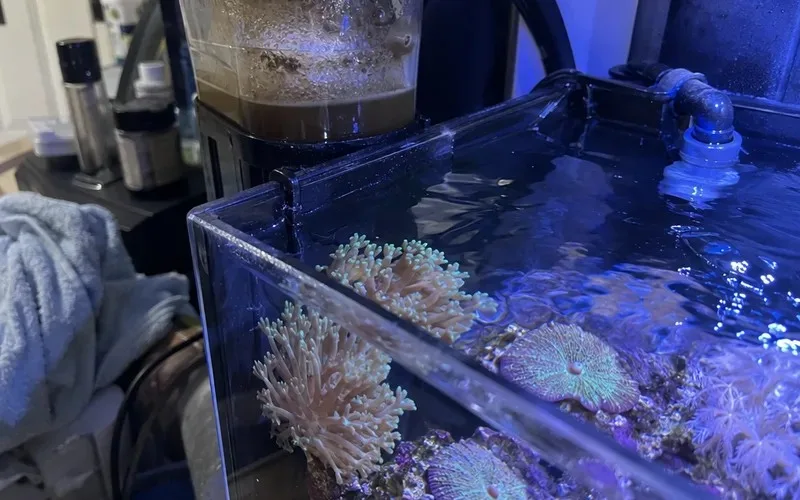
That’s also why a FishLore reply to a new saltwater keeper said “Skimmers are highly recommended.” A skimmer pulls waste out of the water as foam before it ever reaches the canister.
Here’s what I’d do on a reef: run the canister with floss plus a chemical media like carbon or Purigen, and skip the bio media trays.
In other words, give your canister a job it’s good at, and let the rock and skimmer handle the rest.
What Media to Put in a Saltwater Canister Filter
The best media for a saltwater canister filter are fine filter floss to catch debris, plus one or two chemical media such as activated carbon, Seachem Purigen or a GFO phosphate remover.
On a tank with live rock, you can skip ceramic bio media, because the rock already hosts the helpful bacteria and bio trays catch extra waste.
Here’s a simple tray order, top to bottom of the flow:
- Coarse sponge that came with the filter, to stop big debris.
- Fine filter floss, the part you’ll swap most often. The Aquatic Experts FilterFirst floss comes as a 12 x 72 inch roll you can trim to fit canisters, sumps or HOB filters.
- Activated carbon, to clear yellow tint and odors. The MatrixCarbon listing says it “will not raise pH over 7.0.”
- Seachem Purigen, a synthetic resin. Its listing says Seachem Purigen “controls ammonia, nitrites, and nitrates” and is regenerable, so you can recharge it.
- GFO phosphate remover, such as Two Little Fishies PhosBan, if algae or phosphate is a problem.
You don’t need all five at once. For most fish-only tanks, sponge, floss and carbon are plenty.
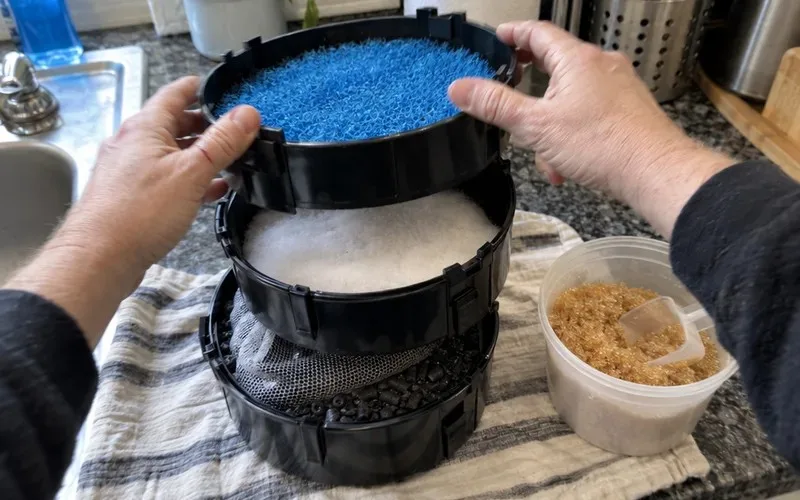
If you want to buy carbon in bulk to save money, compare granular coconut shell carbon options before you refill the tray.
Put chemical media in a mesh bag so you can lift it out in seconds without disturbing the rest.
How Often to Clean a Saltwater Canister Filter
A saltwater canister filter needs its filter floss rinsed or replaced every few days, and never left longer than a week, while carbon, Purigen and GFO get changed when they’re used up.
The floss is the part that traps the waste, so it’s the part that sets your schedule.
Here’s the routine I’d follow:
- Every 3 to 7 days: Pull the floss and toss it or rinse it. The FilterFirst listing says its pad “can be rinsed several times.”
- Every 2 to 4 weeks: Rinse the coarse sponge in tank water you’ve removed during a water change, not tap water.
- When it stops working: Recharge Purigen when it turns dark, and swap carbon and GFO when the water yellows or algae creeps back.
- Every few months: Clean the impeller and hoses, and check the lid seal.
That last check matters more than it looks. A worn lid O-ring is a common cause of canister leaks, and a replacement water filter O-ring costs far less than a flooded floor.
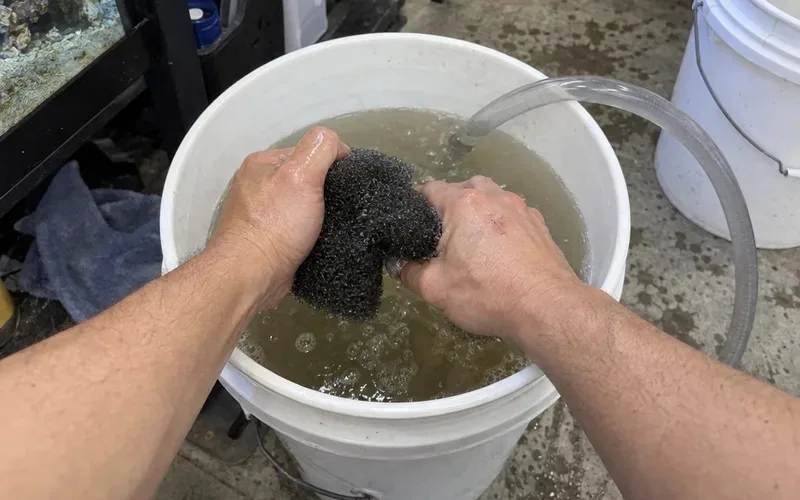
Here’s the deal: if a weekly floss swap feels like too much, a canister probably isn’t the right filter for you. A sump with a filter sock gives you the same job with less hassle.
How to Set Up a Canister Filter on a Saltwater Tank
To set up a canister filter on a saltwater tank, place it below the tank, load it with floss and chemical media, run the intake and return to opposite ends, prime it and check every fitting for leaks before you walk away.
Do the steps in this order and you’ll avoid the most common startup leaks.
- Put the canister below the tank. Canisters rely on gravity to feed water down the intake, so it has to sit lower than the water line, usually inside the stand.
- Load the media. Go from coarse to fine: sponge, floss, then carbon or Purigen.
- Mix your water first. Mix salt into purified water in a separate bucket, and a countertop reverse osmosis filter is one way to make that water without plumbing.
- Set the intake and return far apart. Put the intake low on one side and the return high on the other, so water flows across the whole tank.
- Prime and start it. Fill the canister with tank water or use its primer, then plug it in.
- Check for leaks. Watch every hose fitting and the lid seal for the first hour, then again the next morning.
If you’re on city water, check whether it uses chloramine. A chloramine water filter handles it before the water ever meets salt, or an aquarium water conditioner treats it in the bucket.
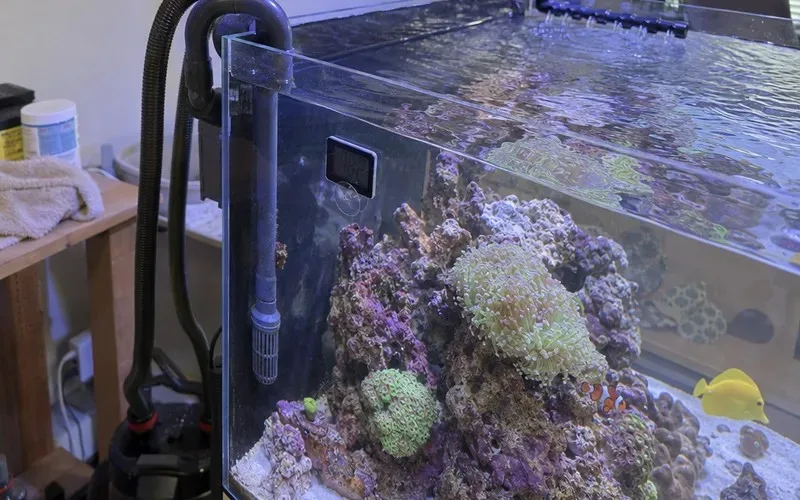
And if your aquarium heater has nowhere to hide without a sump, put it near the canister’s return. That way, the flow spreads warm water through the whole tank.
What Size Canister Filter Do You Need?
You need a canister filter rated for at least your aquarium’s volume, and going one size up is safer on saltwater because the extra flow and media room help with waste.
Read the listed tank size first, then check the flow rate in gallons per hour (GPH).
Here’s an example:
A beginner on a FishLore saltwater forum thread asked if a Fluval 307 could handle a 55-gallon tank. On Amazon, the Fluval 307 is rated for marine tanks up to 70 gallons, so yes, it fits with room to spare.
The listed ratings line up like this for popular canisters:
| Model | Listed tank size | Listed flow |
|---|---|---|
| Fluval 307 | Up to 70 gal | Not listed |
| Aquatop CF‑400UV MKII | Up to 125 gal | 370 GPH |
| SunSun HW-304B | Up to 150 gal | 525 GPH |
| Fluval FX2 | Up to 175 gal | 475 GPH |
| Fluval FX4 | Up to 250 gal | 700 GPH |
These numbers come from each product’s Amazon listing, not from a lab test. So treat them as the maker’s top end, and size up if your tank is heavily stocked.
Match the listed tank size to your tank, then add a margin for a crowded saltwater tank.
Which Canister Filter Should You Buy for Saltwater?
The right canister filter for saltwater depends on your tank size, according to each model’s listing:
- The Fluval 307 suits tanks up to about 70 gallons.
- The Aquatop CF-400UV MKII and SunSun HW-304B cover mid-size tanks with built-in UV.
- The Fluval FX4 handles big tanks up to 250 gallons.
None of them has been tested head to head, so size and features decide it.
Here’s how I’d pick:
- Tanks under 70 gallons: The Fluval 307 is listed for marine tanks up to 70 gallons. Its EZ-Lift baskets lift out together, which makes those frequent floss swaps quicker.
- Mid-size tanks that need UV: The Aquatop CF-400UV MKII lists a built-in 9W UV, 370 GPH and tanks up to 125 gallons. The SunSun HW-304B lists a 9-watt UV sterilizer, 525 GPH and tanks up to 150 gallons.
- Large tanks: The Fluval FX4 is listed for aquariums up to 250 gallons, pumps 700 gallons per hour and holds 1 gallon of media. The Fluval FX2 is the step down, listed for up to 175 gallons.
UV is a nice extra, not a must. The SunSun listing says its UV is for “controlling algae spores/bacteria,” but UV does nothing about trapped waste, so your floss schedule still matters most.
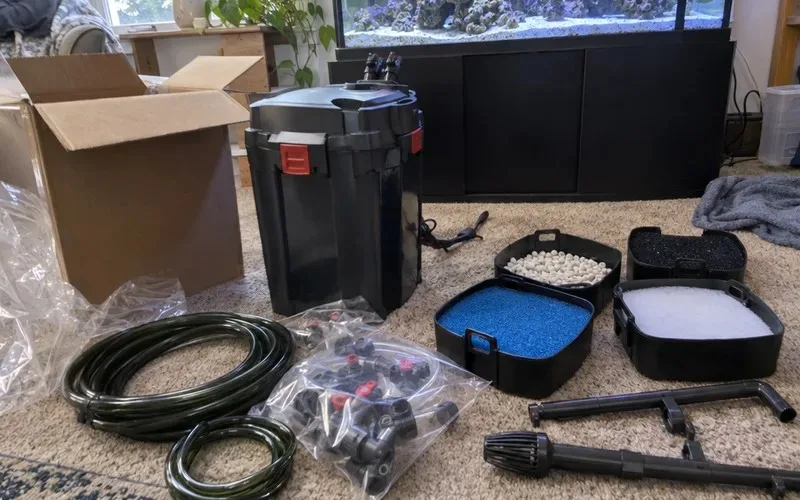
If you keep messier animals in another tank, the same rules apply to turtle tank canister filters, where waste loads run even higher.
The Bottom Line on Saltwater Canister Filters
A canister filter works on saltwater when you treat its floss as something you change, not something you forget.
Pick a canister rated above your tank size, load it with floss and carbon, and set a phone reminder to swap the floss every few days starting this week.
Frequently Asked Questions
Is there a filter for saltwater?
Yes, saltwater tanks use the same filter types as freshwater ones, mainly sumps, canister filters and hang-on-back (HOB) filters. Check the listing before you buy: the Aquatop CF-400UV MKII on Amazon is listed as designed for both freshwater and saltwater tanks.
What is the best canister filter for a saltwater aquarium?
The best canister filter for a saltwater aquarium is the one rated above your tank’s volume, since no head-to-head test exists. By their Amazon listings, the Fluval 307 covers marine tanks up to 70 gallons and the Fluval FX4 covers aquariums up to 250 gallons.
Do you need a protein skimmer with a canister filter?
A protein skimmer isn’t strictly required with a canister filter, but it’s a smart add, and a FishLore forum reply put it plainly: skimmers are highly recommended. The skimmer pulls waste out of the water before it can break down, which takes pressure off the canister.
Can you use a freshwater canister filter for saltwater?
Yes, most canister filters sold for freshwater also run on saltwater, as long as the maker says so. The Fluval 307 on Amazon is listed for freshwater and marine tanks, and the Sicce Space EKO 300 is listed for freshwater and saltwater.