
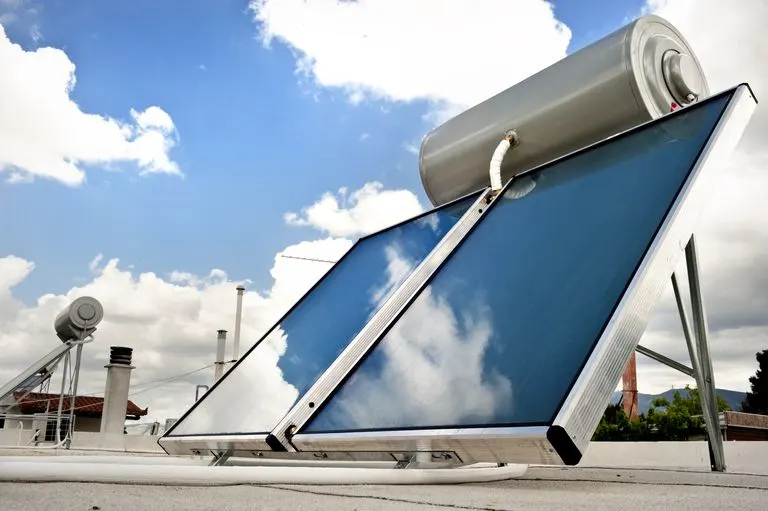
Are solar water heaters worth it? Let’s look at what the numbers actually say.
A solar water heater captures sunlight and turns it into hot water. There are two main approaches: solar thermal systems that directly absorb heat from the sun, and photovoltaic setups that generate electricity to run an electric heater. Solar thermal is by far the more common option.
Some systems come with a backup electric or gas element for cloudy stretches, while others don’t. If you’re exploring energy-efficient alternatives, you might also compare them to a heat pump water heater. But the real question is whether solar water heaters make financial sense for your home.
Let’s break it down.
Solar water heaters can reduce your water heating costs by 50% to 80% and typically pay for themselves within 5 to 10 years. With lifespans of 25 years or more and minimal maintenance requirements, they represent a strong long-term investment for most homeowners.
Financial Payback Time For Solar Water Heaters
The financial payback time of solar water heaters varies considerably with location, thanks to differences in climate and the price of electricity. The payback period is shorter in areas with abundant sunshine and high electricity rates.
Let’s look at a practical example. The standard price of a solar water heater and installation starts in the range of $1,000 to $5,000 for a typical family of four.
The payback period depends heavily on your local energy costs.
Jamaica Example
The cost of electricity in Jamaica is approximately USD $0.45 per kWh, which is very high compared to the U.S. average of approximately USD $0.10 per kWh. This means it will take roughly four times longer for the heater to pay for itself in the United States compared to Jamaica.
If you’re an average family and 33% of your electricity bill goes to water heating, you can calculate your payback time. Multiply 0.33 by your monthly bill to find your monthly water heating cost.
For example, if your annual water heating cost is $79,200 JMD and the solar heater costs $105,000 JMD, the payback time is approximately 1.32 years. The return on investment after five years would be $291,456 JMD.
Importance Of Climate
Because solar water heaters obtain their heat from sunlight, the amount of sunlight available directly affects how much water they can heat. Climate is therefore a vital factor in system performance.
In sunny climates, they supply hot water most of the time. In cloudier atmospheres, a system that harvests sunlight more efficiently is beneficial.
Importance Of Weather To Solar Water Heaters
Because solar water heaters get their energy from sunlight, the quantity of sunshine available directly affects their heating capacity. Weather plays a central role in system performance.
In any climate, backup electric heating elements make sure regardless of how cloudy the weather gets or how long it lasts, there’s always hot water available. Learn more about whether water heater elements are universal if you ever need to replace the backup element. The more overcast the weather, the more the backup elements must be used, and the more your electricity bill will increase.
Weather affects the cost of hot water from the system more than any other factor. The total cost of hot water from a solar system equals the upfront cost including installation plus the cost of electricity consumed by the backup element.
In sunny countries with expensive electricity, solar water heaters pay for themselves the fastest. This makes them an excellent investment in tropical and subtropical regions.
The total cost of hot water from the system equals the upfront cost including installation plus the cost of electricity consumed by the backup element.
Do Solar Water Heaters Work At Night?
Yes, they do. Solar water heaters store water in insulated tanks that retain heat effectively.
The heater collects solar radiation during the day, and the insulation keeps the water hot throughout the night.
It’s easy to understand the growing popularity of solar photovoltaic panels. Once installed, these panels start reducing your electricity bills from day one, and it doesn’t take long for them to pay for themselves. For homeowners not ready for solar, point of use water heaters offer another energy-efficient alternative.
But is the same true for solar water heaters? Are they worth the added expense?
To find the answer, you need to compare the total lifetime costs of a solar water heating system to the total lifetime savings on home energy bills. Let’s review the numbers.
How Much Do Solar Water Heaters Cost To Install And Maintain?
Solar water heater prices vary depending on the size, make, and model of the unit. Prices start as low as $1,000 for basic systems.
With numerous local, state, and federal solar incentives available, you can dramatically reduce the upfront cost of your installation. In some cases, the reduction can be as much as 50 percent of the total cost.
The good news gets even better. With no moving parts, today’s solar water heaters are remarkably resilient.
The solar water heating systems available today are built to last 25 years or more with little to no maintenance required.
How Much Can Solar Water Heating Save On Utility Bills?
Actual savings depend on system size, manufacturer, model, and your home’s average water usage. A family of five will enjoy more substantial savings than a family of two.
According to the U.S. Department of Energy, solar water heaters reduce monthly utility bills by 50 to 80 percent on average.
With savings like that, solar water heaters commonly pay for themselves within 5 to 10 years.
It’s important to remember that current payback periods are tied to today’s utility rates. As energy prices continue to rise, the payback period of your solar water heater becomes even shorter because your installation protects you from increasing electricity costs.
More Reasons Why Solar Water Heating Makes Sense
Lower monthly utility bills are the primary motivation for most solar water heating purchases. But here are additional advantages you should consider.
Ready to take advantage of these benefits and help the environment at the same time?
Fighting Climate Change
Water heating accounts for 17% of a typical home’s energy use. Many North American homes heat water with gas or other fossil fuels, which puts several tons of carbon into the atmosphere each year. If you’re curious, learn whether gas water heaters use electricity at all.
The shift to solar water heating is an excellent way to reduce carbon and other greenhouse emissions and defend our climate. It helps protect the environment while reducing your personal carbon footprint.
Protecting Air Quality
Many homes use electricity to heat their water, and over one-third of U.S. electricity comes from burning coal. Particulates and other byproducts of burning coal contaminate our air and contribute to a variety of adverse environmental and health effects.
When you heat with solar energy, you become part of the solution to these public health issues instead of contributing to the problem.
Protecting Water Quality
Carbon and particulates aren’t the only byproducts of burning fuel. Power plants are the primary source of mercury and other toxic metals being discharged into the environment annually.
These substances are a significant threat to the health of our rivers, streams, and lakes, as well as human health. Solar water heating is one practical step we can all take to stop mercury contamination of our watersheds.
Monthly Savings
A solar water heater can provide up to 80% of your hot water needs, even in temperate climates. This translates to significant utility bill savings month after month.
A solar heating system typically pays for itself in 4 to 8 years and can last for 40 years or more. That represents decades of free hot water and substantial financial savings. Compare that to a tankless electric water heater, which typically lasts 20 years.
Increased Home Value
Studies show that homes with solar features sell faster and at higher prices than comparable homes without them. Adding solar water heating to your home is an investment that pays back whether you keep the home or decide to sell it.
According to the National Renewable Energy Laboratory, for every $1 in annual utility bill savings, your home’s value increases by approximately $20. This makes solar water heating a strong investment for both personal use and property value.
The Magical Advantage Of Solar Energy
As we all know, the sun doesn’t shine all day. Solar water heaters typically have a backup gas or electric element that activates during periods of little or no sunlight.
However, many solar water heater owners prefer using the backup heating as little as possible. Instead, they make a game out of using their hot water when it’s most readily available from solar collection.
Little habit changes like doing laundry on sunny days can add up to even greater environmental and financial savings. Many of these homeowners say that paying attention to their hot water usage has made them more aware of how they use all their resources.
Even though the solar water heater doesn’t save water directly, many owners notice they use less water overall and save even more as a result.
Solar water heaters have become quite popular in recent years. Through plenty of state support, promotion, and subsidies, these products have come a long way in many Asian countries.
They have become quite affordable, and many people have started adopting solar water heaters for their water heating needs.
Several major brands have started manufacturing and selling solar water heaters, and some of them are also available online on e-commerce platforms. The heated water is typically needed for 200 to 300 days per year, making investment in solar water heating a financially viable project.
A solar water heater is a system installed on a terrace or open area where it can receive sunlight. The energy from the sun is converted to heat, which warms the water stored in an insulated tank.
On a sunny day, most solar water heaters can provide water at approximately 68 degrees Celsius.
You can also feed this heated water to an electric geyser, so when sunlight isn’t sufficient, it uses electrical energy to heat the water to the desired temperature. Make sure your backup heater has the correct breaker size to handle the electrical load. This hybrid approach makes sure you always have hot water available regardless of weather conditions.
Where Are Solar Heaters More Efficient?
In cold areas where the temperature is very low during the day, some people use the heated water from their solar system for space heating as well. There’s no standard product available for this application, and it needs to be designed based on specific needs with the help of an installer.
Solar Warmer Varieties And Advantages
There are two primary types of solar water heaters available on the market today, each with distinct advantages for different climates and applications.
FPC (Flat Plate Collectors) System
Flat Plate Collector systems are metallic systems containing an insulated box covered with tempered glass. The box has a layer of copper sheet that’s excellent for absorbing heat, coated with a black coating that improves heat absorption.
The box contains copper tubes arranged vertically and connected at the top and bottom by horizontal copper pipes called headers. Cold water enters the collector from the bottom pipe and rises into the vertical tubes.
As the water gets heated, it becomes lighter (hot water is lighter than cold water), rises, and gets collected in the storage tank via the top header pipe. This water then becomes available for use.
These are durable metallic systems that have an extended lifespan.
ETC (Evacuated Tube Collectors) System
Evacuated Tube Collector systems are made from glass. They have vertical tubes created from two coaxial glass tubes, with the air between them removed to form a vacuum that improves insulation.
The surface of the tubing is coated to provide higher heat absorption and insulation. Cold water fills these glass tubes and gets heated by sunlight, then rises to the storage tank.
These systems are more fragile than FPC systems and need to be handled with care. Both types of water heaters come with or without pumps for water circulation.
The pump is used to move water from the collectors to the storage tank, while those without pumps use the thermosiphon principle to move water automatically.
How To Decide Which Type To Purchase
ETC systems are more fragile but less expensive than FPC systems. They’re also excellent for colder regions where temperatures drop below zero.
In areas where the water is salty, ETC systems need regular cleaning due to salt deposition on the inner surface of the glass tubes. FPC systems are more durable since they’re made from metal, but they cost more than ETC systems.
FPC systems work in sub-zero temperatures as well, but they require an antifreeze solution that adds to the system cost. In places with salty water, a softener is needed with the FPC system to avoid scale deposition that can impact heating capability. You can also use hydrogen peroxide in your water heater to help remove mineral buildup.
In places with salty water, a softener is needed with the FPC system to avoid scale deposition, which can impact the system’s heating capability. A system without a pump is ideal for domestic and small-scale users because it’s cheaper, provided the water doesn’t have high mineral content.
Pump-equipped systems are better suited for industrial and commercial applications where higher volumes of hot water are needed.
How Will The System Perform On Rainy Or Overcast Days?
Many people worry that solar systems won’t work on overcast days. A solar water heater can still function if the overcast period isn’t too long (less than a day or two), because the system works on diffuse radiation present in the atmosphere.
A solar system can be integrated with an existing electric heater that serves as a backup during extended cloudy periods. The electrical system will activate if the water temperature from the solar heater drops below 40 degrees Celsius.
If you’ve an existing electric water heater, a separate electrical backup may not be needed. Check how long your current water heater is expected to last before investing in a solar system. Just in case you don’t have one, you can install an electrical backup unit.
You can also keep the two systems separate and use the electric system only when necessary. This gives you full control over your energy consumption and allows you to maximize your solar savings.
Maintenance Requirements
Maintenance needs are minimal but worth understanding. If you’ve an ETC system, the glass tubes can break due to their fragile nature and may need occasional replacement.
Scaling happens on solar water heaters often, mainly if the water is hard. The collectors need regular cleaning to maintain ideal performance.
If the heater’s outer surface is painted, it may need repainting every 2 to 3 years to prevent corrosion.
Occasional leaks may occur in the system, and local plumbers can typically handle these repairs quickly and affordably. If you’re looking at how long it takes to install a water heater, solar systems generally require more time than conventional units.
Are There Grants Available?
There are provisions for grants and subsidies for the installation of solar water heaters, and the amounts and procedures vary from state to state. Most of the time, installing a solar water heater is economical even without any grant assistance.
You should check the specific grant rules for your state and visit the relevant government website for details on available programs and how to apply. Most of the time, installing a solar water heater is economical even without any subsidy.
Frequently Asked Questions
It really depends on where you live and what you're paying for electricity. In sunny areas with high rates, payback can happen in just 1 to 2 years. The U.S. average is more like 5 to 10 years. After that? It's essentially free hot water for the rest of the system's life.
They do, actually. Solar water heaters can still pull heat from diffuse radiation even on overcast days. Efficiency drops during extended cloudy stretches, but most systems have a backup electric or gas element that kicks in when the sun isn't cooperating.
Surprisingly little. You'll want to clean the collectors occasionally, check for leaks, and inspect insulation. If you have an ETC system, a glass tube might crack and need replacing now and then. Painted surfaces may need a fresh coat every 2 to 3 years to prevent corrosion.
Yes, and they can make a huge difference. Local, state, and federal incentives can knock off as much as 50% of your installation cost. Check with your state energy office or the DSIRE database to see what's available where you live.
Final Thoughts
So, are solar water heaters worth it? Based on everything we've covered, the answer is a pretty clear yes for most homeowners.
The numbers speak for themselves: 50% to 80% savings on water heating bills, a payback period of 5 to 10 years, and systems that last 25 years or more. That's potentially decades of nearly free hot water.
And the benefits go beyond your wallet. You're reducing carbon emissions, protecting air and water quality, and even boosting your home's resale value. It's one of those rare investments where doing the right thing for the environment also happens to save you money.
If you've got a sunny roof and you're tired of high energy bills, a solar water heater is worth serious consideration.